Browser snapshots in Stark: Closing the gap between point-in-time audits and live monitoring
Stark's browser monitoring works in two layers: browser scan snapshots establish your accessibility baseline, and URL assets track that same page continuously — alerting you when issue counts change. Together, they close the gap between a one-off scan and a live monitoring system with documented history.

Team Stark
May 14, 2026
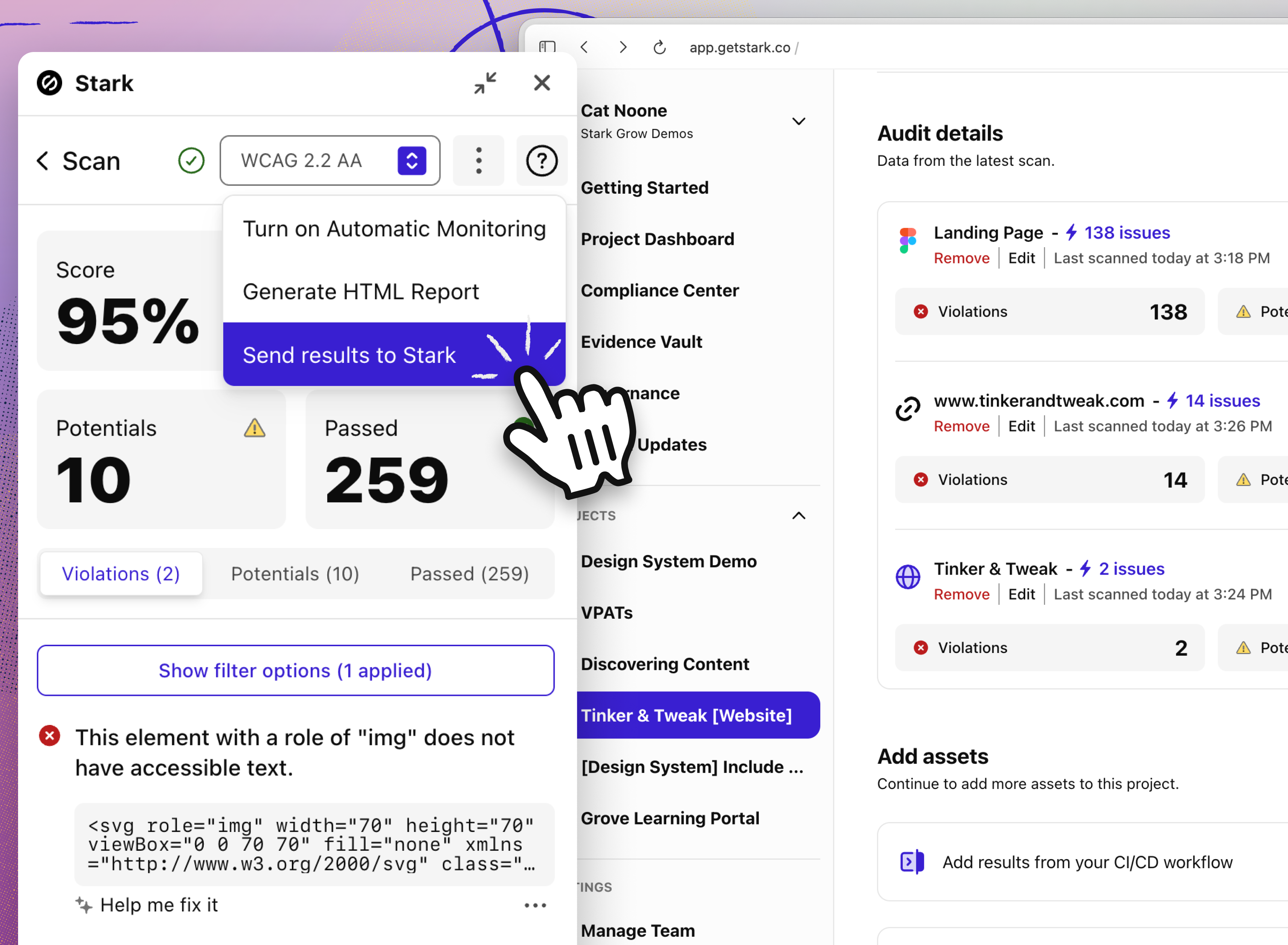
The accessibility audit has always been periodic by necessity — a snapshot in time, but unfortunately not part of a system in motion. Our latest Browser Scan asset in Stark is the mechanism that changes this: each scan becomes a documented baseline that proactive and continuous monitoring builds on, creating a living audit record instead of a one-time finding list.
The model works in two layers. A browser scan captures the accessibility state of a URL at a specific point — with violations, potential violations, and passed checks to establish the baseline. Whether using that to show a “state of affairs”, browser scan snapshots are most powerful when paired with a URL asset which then monitors that same page on an ongoing basis — measuring live state against the snapshot and surfacing regressions as they occur, versus only in the next audit cycle. Together, they move accessibility from a periodic practice to a continuous one.
Snapshots don't expire. Run a new browser scan of the same URL after a redesign or a remediation sprint and the delta is explicit: did issues go up, down, or hold? The comparison is traceable, not anecdotal.
URL assets track changes against that baseline
For teams monitoring critical user flows (e.g. checkout, authentication, onboarding), this is where the QA connection becomes direct. When engineers push a release that introduces regressions, the issue count goes up against the baseline. That's discovered now, not in the next audit cycle — as alerts will go out to email, Slack, or Microsoft Teams digests, to whoever needs to know, based on the frequency of alerts you set.
Browser scans are the foundation of the modern audit
Traditional accessibility audits are point-in-time by design. A firm runs an assessment, produces a finding list, and leaves. By the time that report is acted on, or referenced in a compliance review, the product has changed. The audit reflects a state that no longer exists.
Browser scan assets change the underlying model. Each snapshot becomes a documented checkpoint in the audit record. Layered with continuous URL monitoring, those snapshots accumulate into something a periodic audit can never produce: a timestamped history of what changed, when, and whether it improved — built as a byproduct of normal operations, not scheduled around it.
When an auditor or procurement process asks about accessibility posture, the answer isn't a one-time assessment that predates the current build. It's a living record spanning releases, remediations, and regressions — the documented posture of a mature, governed practice.
Tracking complex auth or private/intranet sites
Because you can run scans against any page your browser is able to navigate to, Browser Scans are a super simple way to scan sites that are behind complex auth (e.g. MFA or magic links) or sites that are on an intranet. This allows you to get results up to your Stark dashboard / projects that you wouldn’t otherwise be able to with our URL scanner. Get a baseline in place by scanning these pages and then run the scans again after you make any fixes to continuously track progress with Stark.
Where to start
Add priority URLs as assets in Stark's browser monitoring settings: public-facing product pages, authentication flows, documentation sites, and any URL that has appeared in past audit findings. Run a browser scan to establish the baseline. URL monitoring begins from there…
💬 Browser Scan's are available now for Launch, Grow, and Scale plans. Don't have access? Kick off a free two-week trial (no credit card required!) straight away.
Feel free to share your thoughts and feedback at support@getstark.co, or join the conversations in our Stark Slack Community, on LinkedIn, and on Twitter.