Stark in Storybook to power your design system accessibility right where it’s built
Stark now integrates directly into Storybook, bringing continuous accessibility monitoring across your entire component library — every story, every variation, tracked over time. Regressions in your design system surface the moment they appear, before they propagate downstream to the products built from your components.

Team Stark
Apr 16, 2026
Stark now integrates directly into Storybook to automate scanning across your entire component library, tracked over time, with regressions surfaced the moment they appear.
Why? Design systems are how modern software teams scale UI. Components get built, documented, tested, and reused across every product surface. When the system works, consistency compounds. When it doesn't, inconsistency compounds just as fast but the impact is one that generates expenses, not revenue.
Accessibility heightens this. If the components in your design system aren't accessible, nothing assembled from them will be either. The defect doesn't stay local, but instead propagates everywhere the component and instances of it ships. And in all organizations, before Stark it was incredibly difficult to monitor that at the component level across a spectrum of software with tens of thousands of people working on it at any point in time.
When we realized the power of monitoring design systems across the entire software cycle using Stark, we knew we had to take it one notch further…
How Stark and Storybook become a dynamic duo
The original Stark Storybook add-on (released into beta earlier this year) let you run a WCAG audit on individual stories which was useful for spot-checking during development, but manual and untracked. You'd open a story, run the audit, see the results, and move on. While it’s certainly utilizing our engine which catches what others miss, it still had no history over time, insights from that progress, or a way to easily and clearly determine if last week's accessible component is still accessible today. Not our preferred style!
Now, with Stark’s CLI, it automatically builds your Storybook and iterates through every story in your library. Each one gets a full WCAG audit. Results are continually synced to Stark as a tracked asset — the same way source code scans, designs in Figma, CI/CD results, and more flow into the platform. You configure it once with a project token and asset name, and from that point forward, your design system's accessibility posture is monitored continuously.
What that means in practice:
-
Full-library scanning → Every component, every story, every variation — not just the cones someone remembered to check manually.
-
Tracked over time → Results sit with the rest of your resource tracking in Stark, so you can see progress and regressions across your entire component library.
-
CI/CD integration → Run it in your pipeline so every push is scanned automatically — the same pattern as source code scanning.
-
Regression detection → When a component that was accessible stops being accessible, you know immediately — not after a quarterly audit.
And because Stark already scans at the source code and CI/CD layers, adding Storybook means coverage compounds. The same repo can have its code scanned for accessibility issues and its built Storybook scanned for component-level regressions — two layers of visibility from a single codebase. More surface area covered means fewer issues reaching production undetected.
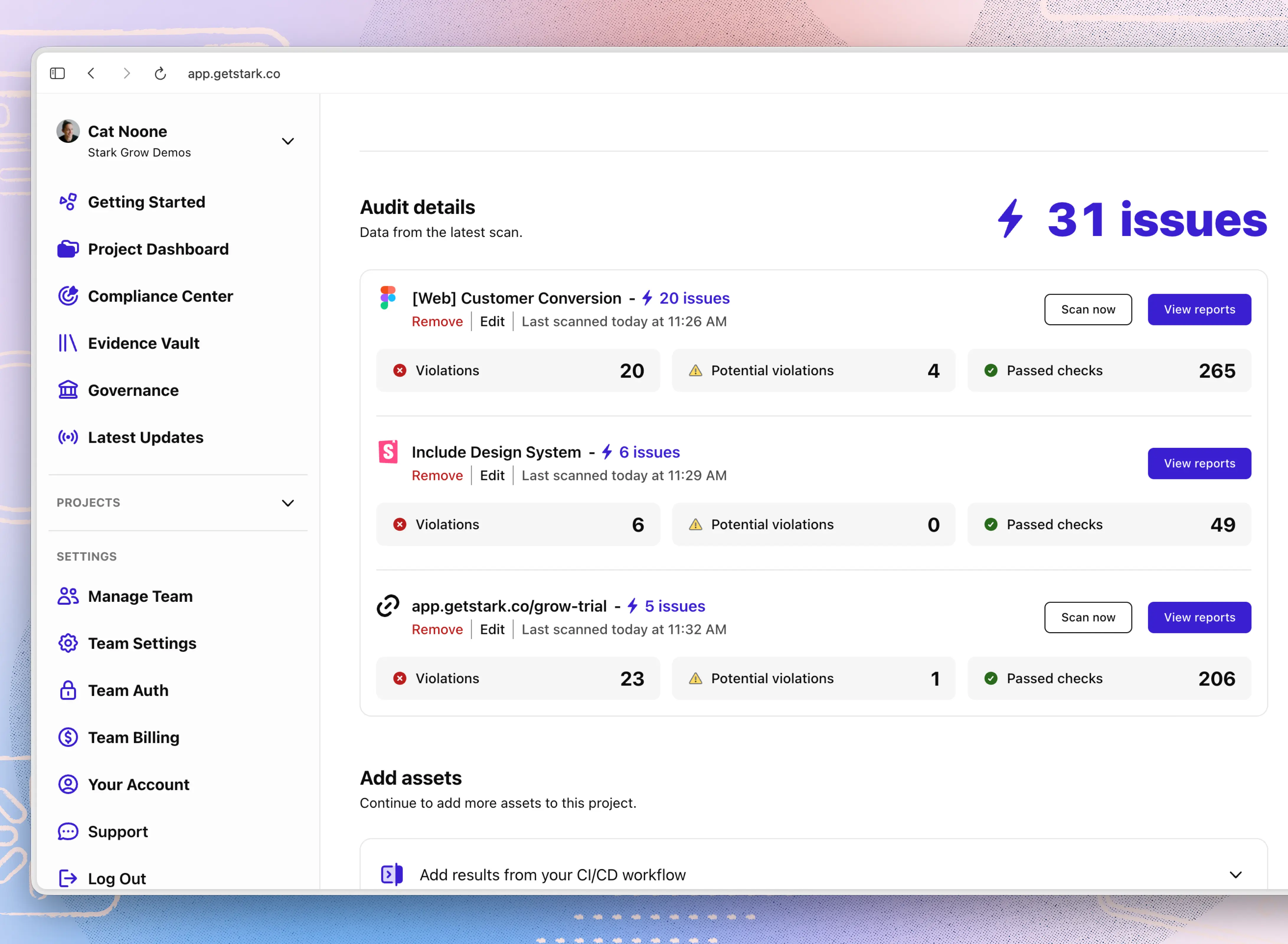
Supporting your design system infrastructure
Most accessibility testing still happens later in the product lifecycle, if not after shipping to production — scan the page, file issues, remediate. That workflow catches problems, but it catches them late, after inaccessible components have already been assembled and shipped. And in a time where AI maximizes shipping speed and velocity, the same defect in a single component can surface as hundreds or thousands of separate findings across different products, each triaged and fixed independently, when the root cause lives upstream in the design system.
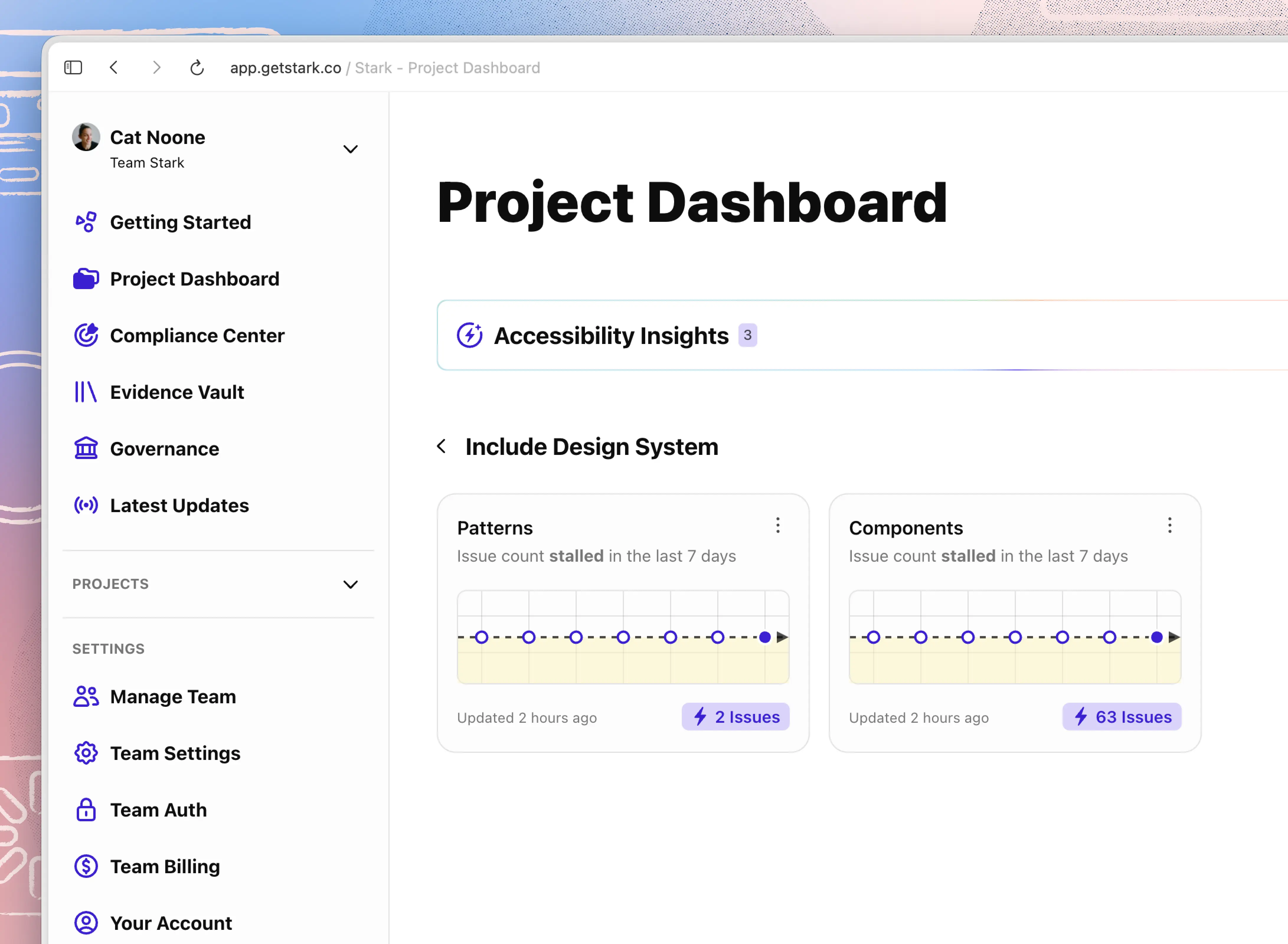
Monitoring at the component level inverts that. Fix the component once, and every product that consumes it inherits the fix. Catch a regression in the design system, and you've caught it everywhere downstream. Component-level accessibility data flows into the same reporting layer as source code scans, CI/CD results, and other monitoring — giving teams a complete picture from design system to deployed product.
Design Systems are serious business in organizations. I mean…they have their own teams and everything. And teams that have invested in design systems already believe in the premise: build it right once, reuse it everywhere. Continuous accessibility at the component level is that same premise applied to the thing that matters most — ensuring the software is usable by everyone who needs it.
💬 Stark's Storybook integration is available now. If your team designs and builds with Storybook, your design system's accessibility posture is one scan away from being accessible across the board. Kick off a free two-week trial (no credit card required!) straight away.
Feel free to share your thoughts and feedback at support@getstark.co, or join the conversations in our Stark Slack Community, on LinkedIn, and on Twitter.